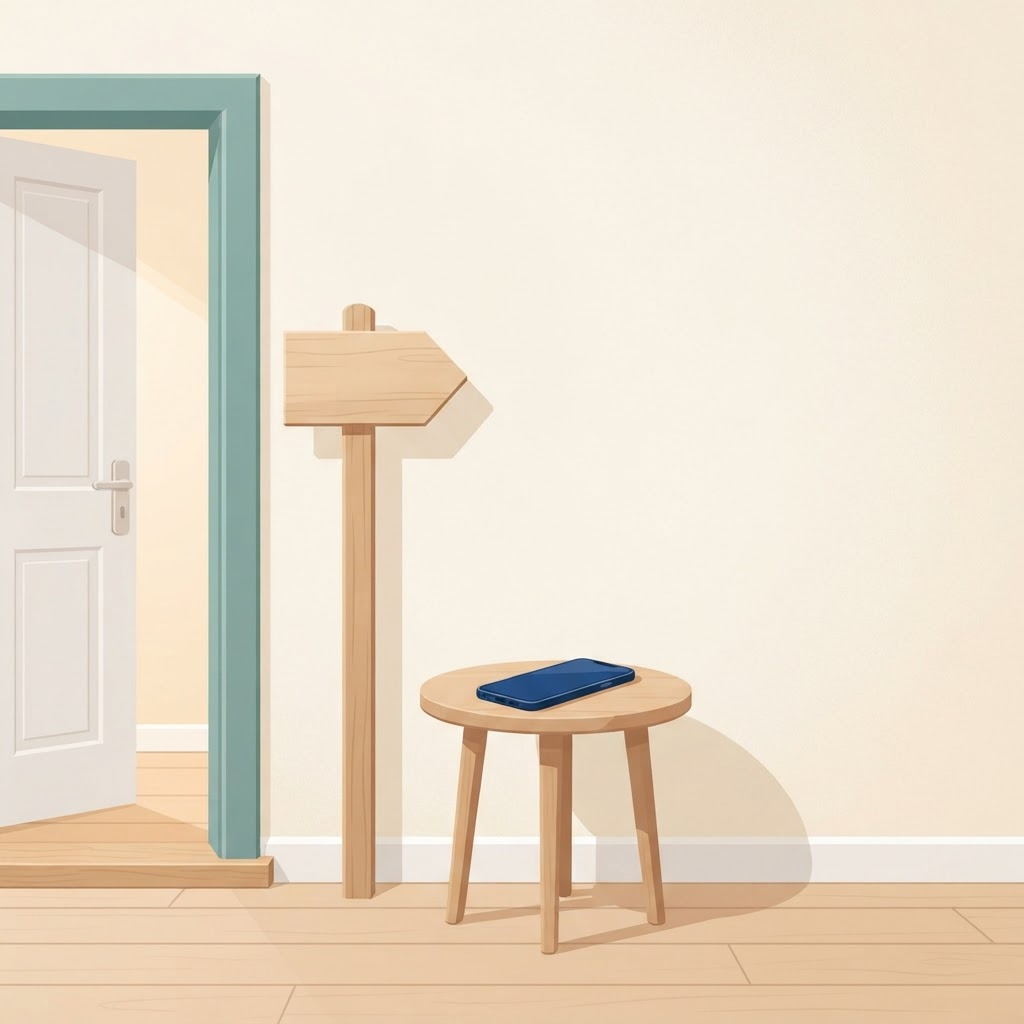
The adhan begins while a game is reaching its final round or a video is halfway through. A parent calls, a child asks for “two more minutes,” and a daily act of worship becomes the start of a daily argument.
This is not only a screen-time problem. It is a transition problem, a household-rhythm problem and, ultimately, a question of what children learn deserves to organise the day.
The answer is not to make every device the enemy. It is to build a family routine in which technology has a place—but does not decide when salah must wait.
Why stopping can feel so difficult
Games, videos and social feeds are designed to continue. A round has consequences for a team. A video begins another automatically. A message creates pressure to answer. Stopping without warning can therefore feel like an abrupt loss, especially to a younger child who is still developing self-regulation.
Understanding that difficulty does not mean surrendering the boundary. It means designing the transition better.
Let salah anchor the routine
The Qur’an describes prayer as an act established for the remembrance of Allah. In family life, the prayer times can become natural anchors around which other activities are organised.
Instead of treating salah as an interruption to screen time, reverse the order: screens fit around prayer. That may mean:
- no new game shortly before a prayer time;
- finishing homework or entertainment with a predictable warning;
- devices remaining outside the prayer space;
- resuming a permitted activity afterwards when appropriate; and
- planning family meals and evening routines around Maghrib and Isha.
A boundary is easier to accept when it is known before the device is switched on.
Use a transition, not an ambush
Give a warning that matches the activity: “The next round is your last one before Maghrib,” or “Pause at the next natural stopping point.” For younger children, a visible timer can make the boundary feel less personal.
Where a game cannot be paused, agree before play begins what happens if prayer time arrives. The child may need to avoid starting that mode near salah rather than using the game’s design as a reason to delay indefinitely.
Consistency matters more than volume. A calm rule repeated every day usually teaches more than an angry demand applied unpredictably.
Do not make salah the punishment
If every call to prayer arrives with shouting, confiscation and resentment, a child can begin associating salah with the loss of something enjoyable. The boundary may still be necessary, but the emotional atmosphere matters.
Use neutral language: “It is time for salah; the device waits.” Avoid turning the moment into a speech about addiction or a comparison with other children. Address repeated rule-breaking later, once the prayer has not become the battleground.
Parents set the visible standard
Children notice when adults demand that games stop while continuing to scroll through messages. If prayer is the anchor, it should interrupt the parent’s screen too.
A few visible habits carry weight:
- putting the phone down when the adhan begins;
- keeping the prayer area device-free;
- not checking notifications immediately after the salam;
- allowing family conversation to continue without a phone on the table; and
- acknowledging when adults also struggle with distraction.
The child learns that the rule expresses a family value rather than a restriction imposed only on the young.
Build a realistic family rhythm
- Map the difficult prayer times. For many homes, Maghrib competes with homework, dinner and entertainment, while Fajr and Isha raise sleep questions. Solve the actual friction in your household.
- Create screen-free buffers. A short period before prayer allows attention to settle. The exact length can vary by age and family routine.
- Choose device parking places. Decide where phones, tablets and controllers wait during prayer and overnight.
- Protect sleep. Devices in bedrooms can make late-night use easier and Fajr harder. A shared charging point removes a daily negotiation.
- Review notifications. Disable non-essential alerts and autoplay where possible. Fewer interruptions make deliberate use easier for adults and children.
- Use technical schedules carefully. Bedtime or access schedules can support an agreed routine, but explain the boundary first. A sudden disconnection without context teaches frustration, not self-control.
- Leave room for exceptions. School work, travel, illness and changing prayer times require judgement. Consistency is not the same as rigidity.
Talk about purpose, not only minutes
A useful family conversation goes beyond “How much screen time?” Ask:
- What was the device being used for?
- What did it replace—sleep, study, movement, family time or salah?
- Was stopping possible when it was time to stop?
- Did the activity leave the child calm, informed and connected—or agitated and unable to disengage?
Two hours spent creating, learning or speaking to family is not identical to two hours of compulsive scrolling. At the same time, a beneficial activity still needs to yield when an obligation arrives.
A thought to hold
The aim is not to produce a home in which children fear screens or resent prayer. It is to teach order: tools serve a purpose, entertainment has limits, and salah retains its place at the centre of the day.
Fitra Guard’s Complete Family Protection can support household access and bedtime routines on configured profiles. Technical schedules work best when they reinforce a family agreement rather than replacing it. The lasting outcome is a child who learns to stop willingly—even when no filter or parent is present.